

One Health Communications

Canada’s ability to prepare for and respond to complex health challenges depends on timely, clear, and coordinated communication across sectors. We are addressing this by co-developing a knowledge-sharing platform that helps practitioners act on health threats more effectively. Grounded in a ‘One Health’ approach that recognizes the interconnectedness of environmental, animal, and human health, this project focuses on translating knowledge into action while bringing together diverse perspectives.
In collaboration with partners in Fraser Health and Northern Health, British Columbia, and Wellington-Dufferin-Guelph Public Health, Ontario, we are exploring how local contexts influence regional communication needs. By combining insights from health research with innovative communication strategies, this project aims to strengthen Canada’s capacity to respond to current and emerging One Health issues that affect the health of people, animals, and ecosystems.
Outcomes
-
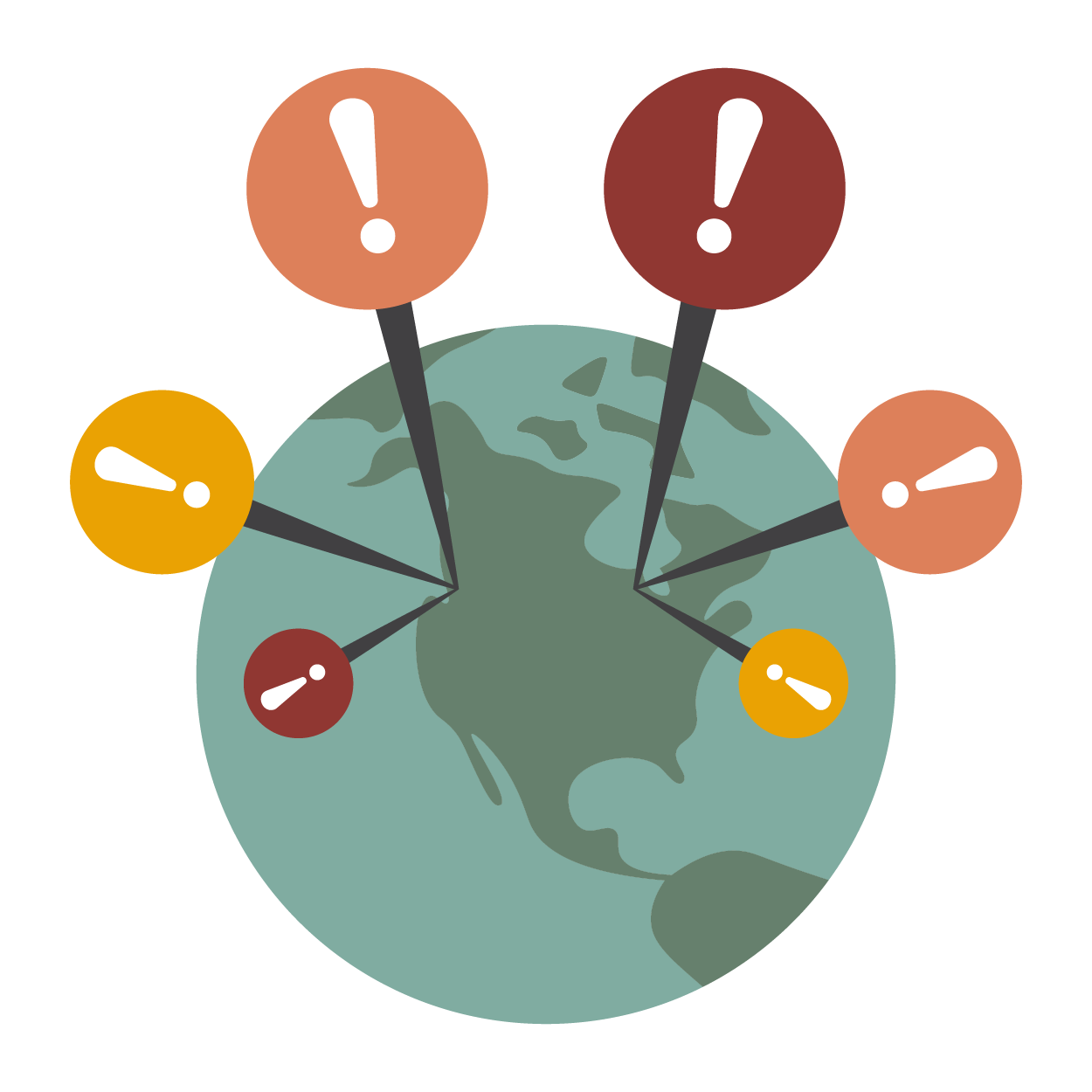
Identifying Regional One Health Issues
We are conducting systematic reviews and working with health professionals and policymakers in British Columbia and Ontario to understand which One Health problems (e.g. zoonotic diseases, climate-related risks, and environmental exposures) impact their regions most and how practitioners collaborate to manage them.
-

Mapping Global Communication Systems
We review how governments and partner organizations around the world share One Health information. By analyzing these communication platforms and data-sharing systems, the study identifies practical models and lessons that can guide regional approaches in Canada.
-

Understanding Regional Needs
In collaboration with stakeholders in health practice, government, and academia, this project will identify the unique communication needs, challenges, and opportunities in each region. By showing how local contexts influence information sharing, we will generate knowledge that strengthens regional capacity to respond to health threats.
-
Developing a One Health Communications Platform
Informed by these insights, we will co-develop a platform that supports timely, coordinated information exchange across human, animal, and environmental health sectors. Designed with input from practitioners and policymakers, the platform will be adaptable and scalable, offering a model that can be extended across Canada to improve preparedness and response to emerging health risks.
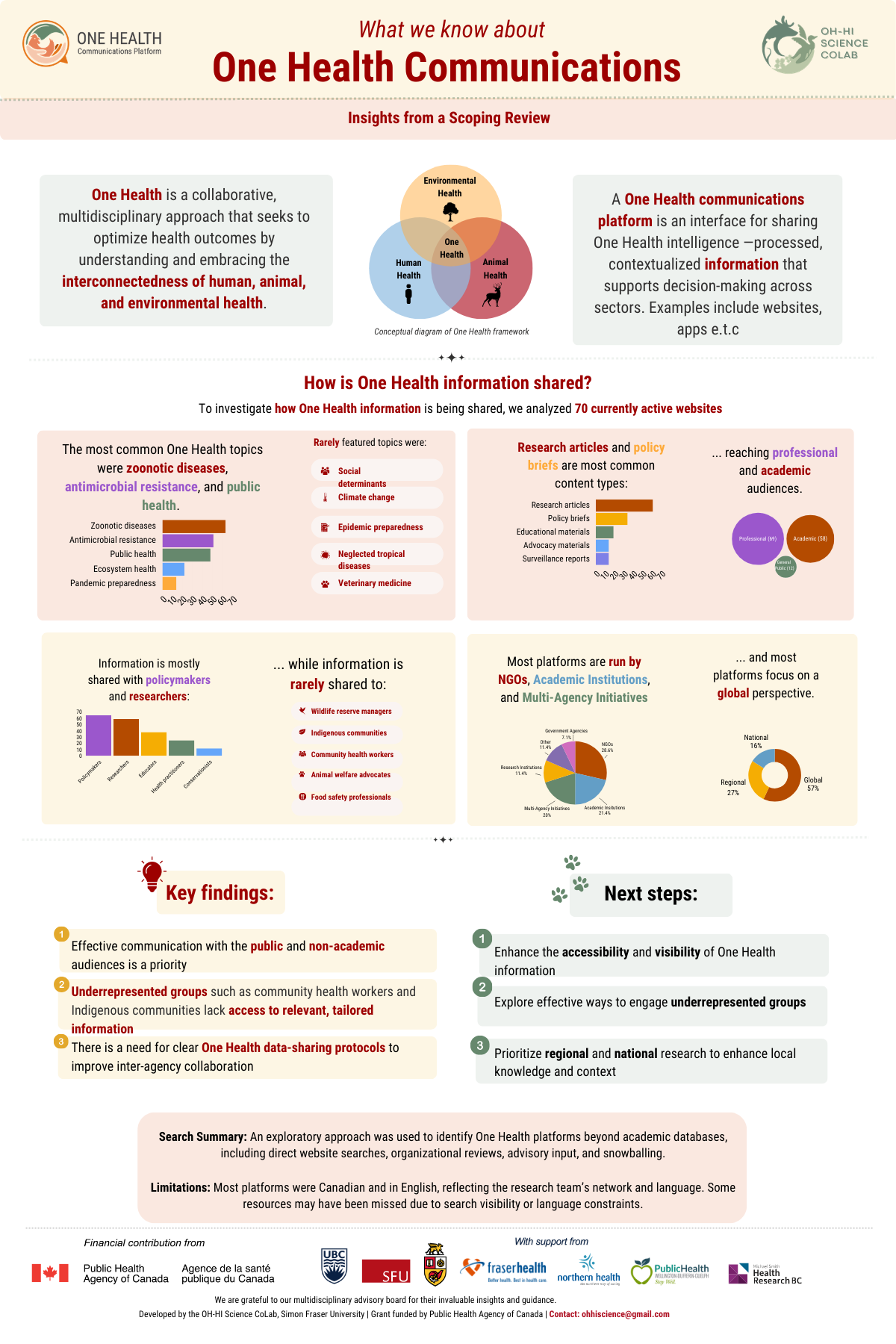
Mapping One Health Communication Systems
This study reviewed more than 70 active One Health websites and platforms run by governments and allied groups worldwide. It shows how information is shared, where gaps exist, and what lessons can inform better coordination in Canada.
Research in Action
-

Why ‘One Health’ needs more social sciences: Pandemic prevention depends on behaviour as well as biology
Byers, K., Hollmann, L., Bukachi, S. A., & Robinson, S. (2024, March 7). The Conversation.
-
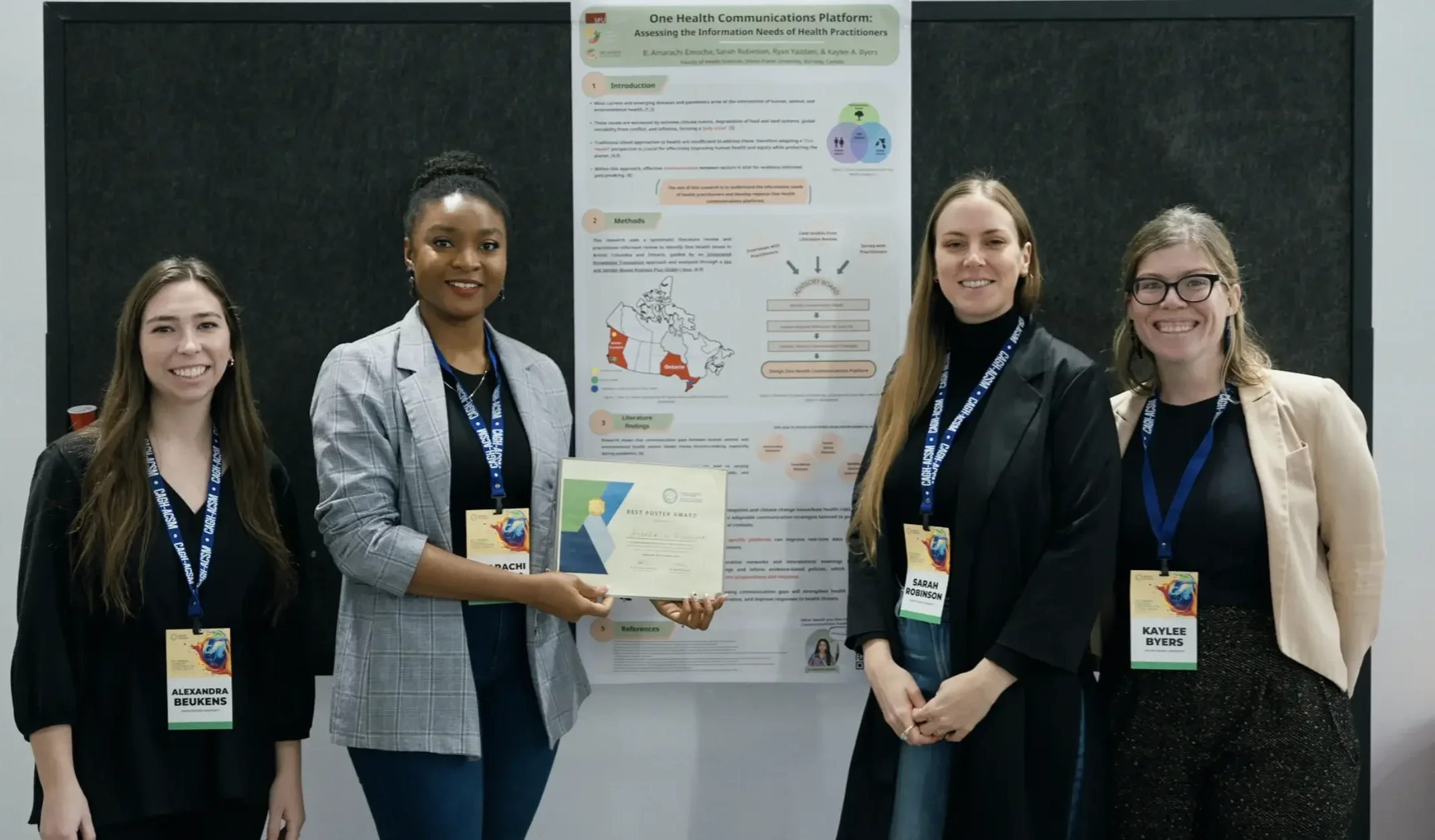
Canadian Conference for Global Health 2024
The OH-HI Science CoLab team received the Elizabeth & Donald Hillman Award at the 2024 Canadian Conference on Global Health. The conference theme, “Poly-crisis and Global Health: How can we improve human health and equity while protecting the planet?”, reflected the collaborative spirit behind this project.
-
2024-2025 Annual report
The One Health Communications Project has made significant strides in establishing a foundation for developing a robust and sustainable communication platform.
-

One Health Video
This short video introduces the One Health approach, why it is important and shows how our project helps health professionals respond better to emerging health risks.
-
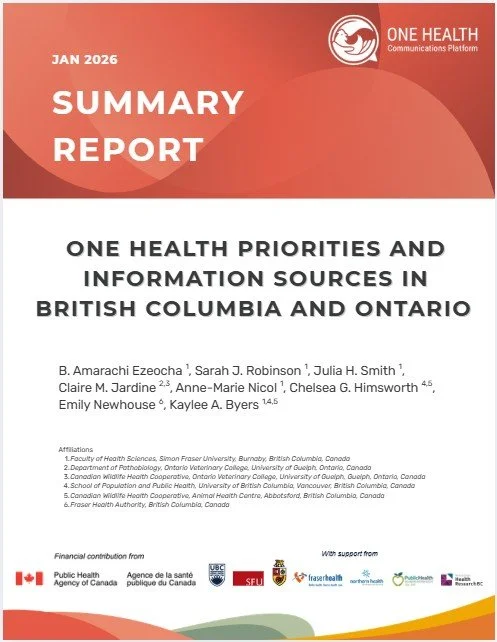
Key Informant Summary report
This report shares findings from interviews with health researchers, practitioners and government health officials across British Columbia and Ontario on how One Health information is communicated and practiced.
-
2025-2026 Annual report
The One Health Communications Project advanced its efforts by enhancing knowledge sharing, strengthening partnerships, and expanding communication opportunities across the One Health community.
One Health Video
This short video introduces the One Health approach, why it is important and shows how our project helps health professionals respond better to emerging health risks.
FAQs
*
FAQs *
How does this project improve communication?
This project partners with health authorities in British Columbia and Ontario to understand how information is shared across sectors. What we learn helps shape practical ways to connect people and systems, so that when new risks emerge, the right information reaches the right people quickly and clearly.


What is One Health?
One Health is a way of thinking and working that recognizes the connection between the health of people, animals, and the environment. It brings different groups together to solve shared problems such as diseases that spread between animals and people, water quality, and climate change impacts.
Why is our focus on communication?
Even when the right information exists, it doesn’t always reach the people who need it in time. Strong communication between health professionals helps link human, animal, and environmental systems so responses are faster, clearer, and based on shared understanding.
This work is made possible by:
Our national, cross-sector advisory board
Andrea Osborn (Community for Emerging and Zoonotic Diseases), Cécile Aenishaenslin (Université de Montréal), Erin Fraser (BC Centre for Disease Control), Gigi Lin (BC Ministry of Agriculture and Food), Heather Richards (Ministry of Health, Ontario), Jolene Giacinti (Environment and Climate Change Canada), Katherine Paphitis (Public Health Ontario), Kerry Schutten (Faculty of Veterinary Medicine, University of Calgary), Kevin Afra (Fraser Health), Lisa Ronald (Northern Health), Lupin Battersby (Simon Fraser University), Melissa Lem (Canadian Association of Physicians for the Environment), Nicola Mercer (Wellington-Dufferin-Guelph Public Health), Raina Fumerton (Northern Health), Sean Hillier (York University), Stefan Iwasawa (BC Centre for Disease Control) and Terri Aldred (National Collaborating Centre for Indigenous Health).

Collaborators
-

Dr. Kaylee Byers
Assistant Professor, UBC / Adjunct Professor, SFU
-

Dr. Sarah Robinson
Postdoctoral Fellow, SFU
-

Dr. Julia Smith
Assistant Professor, SFU
-

Dr. Chelsea Himsworth
Associate Professor, UBC
-

Dr. Claire Jardine
Associate Professor, University of Guelph
-

Dr. Emily Newhouse
Medical Health Officer, Fraser Health Authority / Clinical Assistant Professor, UBC
-

Dr. Anne-Marie Nicol
Associate Professor, SFU
-

Dr. Amarachi Ezeocha
PhD Candidate, SFU

The views expressed herein do not necessarily represent the views of the Public Health Agency of Canada.